
What is Chestny Znak (Honest Sign)? A guide to Russia's mandatory labelling for exporters (2026)
In short
Chestny Znak is Russia's mandatory product labelling system. CRPT generates the codes, the Russian importer orders them and passes them to you, and you print them, preferably at your factory. In 2026, confectionery, bakery products, tea, coffee, meat, grocery staples and radio-electronics came into scope.
- CRPT generates and distributes the codes; responsibility for labelling lies with the Russian importer.
- The code is applied before customs clearance, preferably at the production facility in Türkiye or at a warehouse in Russia before customs clearance.
- Since 1 May 2026, applying codes is mandatory for radio-electronic products and for bakery products and cakes.
- Under a 2019 decision, the fee is 50 kopecks per code excluding VAT; confirm the current amount with your importer.
In this article
- What is Chestny Znak (Honest Sign) and who runs it?
- Which product groups require mandatory labelling?
- What changed in 2026: the 1 May expansion and transition periods
- Who prints the code: the Russian importer or the Turkish manufacturer?
- Registration and code steps, and the cost per code
- Risks of unlabelled goods
- Pre-shipment checklist for Russia
If your Russian buyer has added a note to the order saying "goods must arrive with Chestny Znak codes", you do not have to find the codes yourself: the Russian system operator, the Center for Development of Advanced Technologies (CRPT), generates and distributes them, and the Russian importer places the order and forwards the codes to you (Turkish Ministry of Trade). Your job is to print the code you receive on the product before customs clearance, preferably at your own production facility. Below you will find which products are in scope, which dates took effect in 2026, what a code costs and what to check before shipment.
What is Chestny Znak (Honest Sign) and who runs it?
Chestny Znak (Russian: Честный знак, "Honest Sign") is Russia's national mandatory product labelling and track-and-trace system, and CRPT is the body that built, implements and operates it, including generating and distributing the codes (Turkish Ministry of Trade). The Ministry of Industry and Trade coordinates the system, the Ministry of Digital Development, Communications and Mass Media is responsible for overseeing its operation, and the Ministry of Finance acts as the regulator.
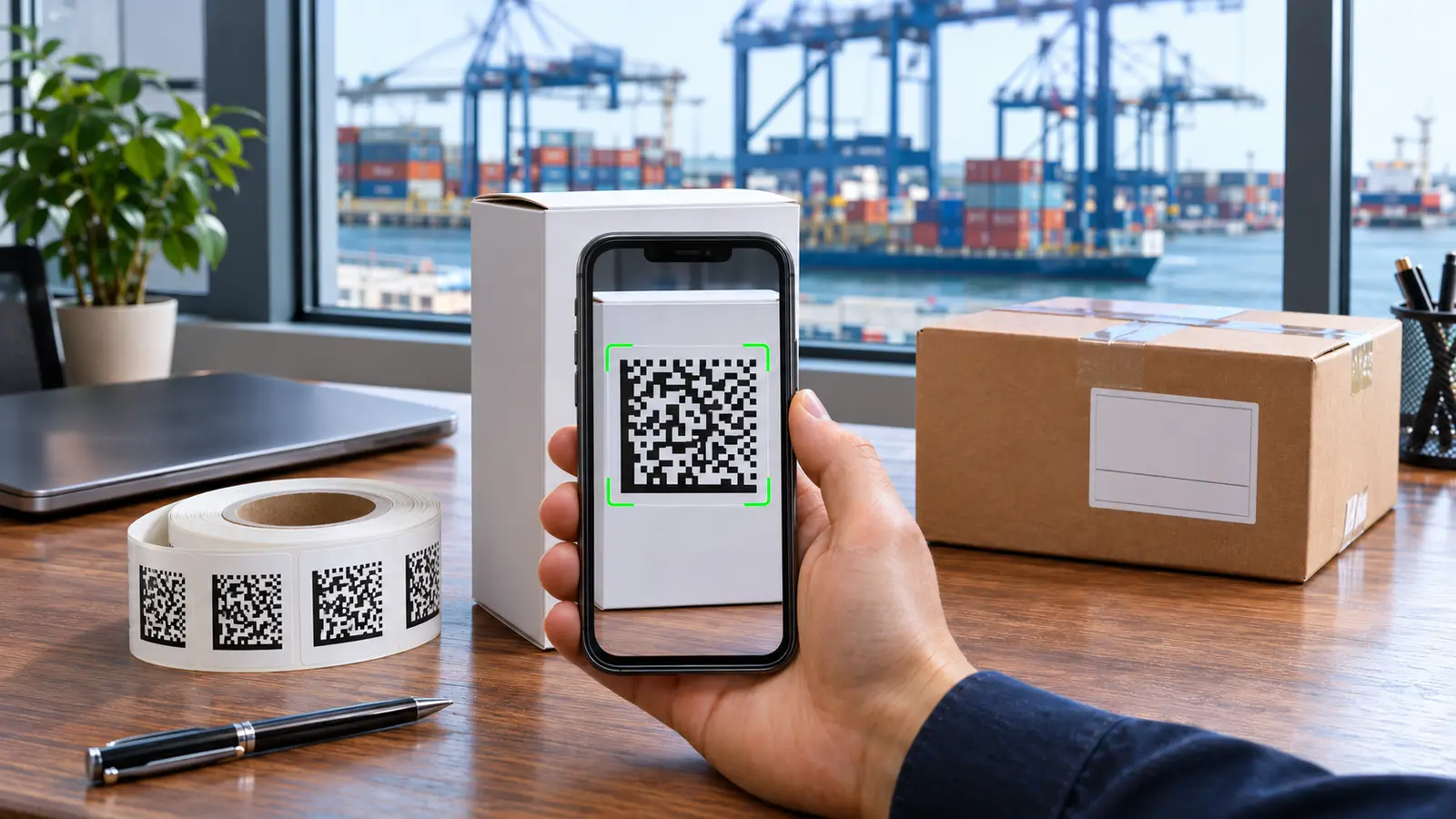
The label printed on the product carries a 14-digit product code, a 13-digit serial number unique to the item, consumption and production dates, and a four-digit verification code. Russian consumers can scan this label with a smartphone to view the product's details (Turkish Ministry of Trade). The code is printed as a two-dimensional barcode; the decision on radio-electronic products, for example, requires it in Data Matrix format, a small square code (Government of the Russian Federation 2026). Each package therefore travels with its own identity, and the square code your buyer is asking for is the on-pack form of that identity.
Which product groups require mandatory labelling?
The scope is wide: footwear, textiles and apparel, dairy products, perfumery, tyres, bottled water, medicines and medical devices are among the groups subject to mandatory labelling. The list also includes fur coats, tobacco, cameras and flashes, beer and low-alcohol drinks, soft drinks, dietary supplements, antiseptics and disinfectants, wheelchairs, caviar, bicycles, veterinary medicines, vegetable oils, animal feed, canned goods and non-alcoholic beer (Turkish Ministry of Trade).
In the groups Turkish exporters meet most often, the transition moved at different speeds. Labelling of textiles and apparel became mandatory on 1 January 2021 (Turkish Ministry of Trade). For the additional light-industry products brought into scope on 1 March 2025, releasing unlabelled imports into free circulation has been banned since 1 July 2025, and selling goods that remain unlabelled has been banned since 1 January 2026.
Cosmetics and household chemicals followed a three-step timeline: labelling became mandatory for soap and detergents on 1 May 2025, for hair and shaving products and deodorants on 1 July 2025, and for cosmetics and toothpaste on 1 October 2025 (Turkish Ministry of Trade). For construction materials, the pilot ended on 31 August 2025 and registration in the system began on 1 September 2025. For motor oil, manufacturers and importers have been required to apply the code and file the import notification since 1 September 2025.
You find out whether your product is in scope from its customs tariff number (Turkish: GTİP, the Turkish tariff statistics code) rather than its product name. The information note from Türkiye's Ministry of Trade lists, for each group, the tariff numbers and Russia's product classification codes (OKPD 2) separately (Turkish Ministry of Trade). Compare your own tariff number with this list and with the code your buyer has given you.
What changed in 2026: the 1 May expansion and transition periods
In 2026 the scope grew quickly on the food and electronics side. The busiest date was 1 May 2026: from that day, manufacturers and importers must apply codes to radio-electronic products as well as to bakery products and cakes (Turkish Ministry of Trade). The 2026 deadlines at a glance (Government of the Russian Federation 2026):
Date | Product group |
|---|---|
1 March 2026 | Biscuits, marmalade, wafers, oriental sweets, spreads |
1 April 2026 | Tea |
1 May 2026 | Bakery products and cakes; radio-electronic products |
1 June 2026 | Coffee and chicory |
1 July 2026 | Chocolate products, dragées, caramel, chewing gum |
1 August 2026 | Meat products |
1 September 2026 | Pasta, honey, muesli, ready potato products |
1 October 2026 | Sausages and charcuterie |
1 December 2026 | Flour, cereals, cereal and dough mixes; Section IV radio-electronic products |
Details and transition periods follow below.
For confectionery and sweets, the pilot ran from 1 March to 31 August 2025, and registration in the system began on 1 September 2025 (Turkish Ministry of Trade). Code application arrived in three stages:
1 March 2026: biscuits, marmalade, marshmallow-type sweets, pastila, oriental sweets, wafers, chocolate, hazelnut and other spreads
1 May 2026: bakery products such as croissants, pastries and rolls, and cakes
1 July 2026: chocolate products, dragées, caramel and chewing gum
If you ship Turkish delight (lokum) or halva, confirm with your buyer which tariff line your product falls under; the date is set by that line.
For radio-electronic products, the test and pilot period ran from 1 December 2023 to 28 February 2026, registration of all market participants began on 1 March 2026, and from 1 May 2026 manufacturers and importers have had to apply the code and put the product into circulation with it (Turkish Ministry of Trade). Amendment No. 577 of 21 May 2026 added a separate Section IV to the list, and code application and circulation reporting for products in that section begin on 1 December 2026 (Government of the Russian Federation 2026). The same amendment grants two transition periods:
Section IV products purchased by 30 November 2026 may be labelled until 28 February 2027.
Section IV products produced or imported by 30 November 2026 and still unsold in Russia on 1 December 2026 may be labelled until 30 November 2027.
These periods apply to stock already in Russia. If your new shipment will reach customs after 1 December 2026, plan for the product to leave with its code. For radio-electronic products in Sections I-III, reporting of circulation data to the system begins on 1 December 2026 (Government of the Russian Federation 2026).
Across the rest of the food sector the dates came one after another. Tea moved to code application on 1 April 2026, and coffee and chicory on 1 June 2026 (Turkish Ministry of Trade). For meat products, code application and circulation reporting became mandatory on 1 August 2026 for general meat products and on 1 October 2026 for sausages and charcuterie. In the grocery group, pasta, honey, muesli and ready potato products join the system on 1 September 2026, and flour, cereals, cereal mixes and dough mixes on 1 December 2026.
Russian authorities say additional transition periods may be granted product by product, depending on industry readiness and stock levels. Türkiye's Ministry of Trade, however, advises you not to wait for the deadline: a company that starts early sees shipment problems early and learns the process by doing (Turkish Ministry of Trade).
Who prints the code: the Russian importer or the Turkish manufacturer?
The Russian importer is the party responsible for labelling, and passing the label or barcode data to the manufacturer is also its job (Turkish Ministry of Trade). You do not order the codes yourself. Your buyer must be registered in the system, define your product in the catalogue and send you the codes.
Physical printing, however, usually happens on your side. Labelling must be completed before the goods are cleared through customs; the preferred place is the production facility, and the other option is a warehouse in Russia before customs clearance (Turkish Ministry of Trade). From the importer's order to the code printed on the product, the work is usually split into three steps:
The Russian importer orders the codes from CRPT and forwards them to you.
You print the codes on the product or consumer packaging on the production line.
The importer reports the printed codes to the system and puts the product into circulation.
The warehouse option exists on paper, but opening every carton in Russia and labelling items one by one means extra time and cost. Writing into your contract with the buyer how many days in advance, at the latest, the codes must reach you makes your work easier.
Registration and code steps, and the cost per code
The Russian market participant handles registration: it obtains an e-signature from a centre accredited by the Ministry of Digital Development, downloads the required software and registers through the CRPT registration page (Turkish Ministry of Trade). After registration, the participant must carry out code ordering, application to the product, reporting, payment and release of goods to the market in full.
The code fee was set by a 2019 government decision at 50 kopecks per labelling code, excluding VAT (Government of the Russian Federation 2019). The operator has charged this fee since 1 July 2019. There is one exception: no code fee is charged for medicines on the list of vital and essential drugs whose maximum manufacturer selling price does not exceed 20 roubles. This is the figure from the 2019 decision; confirm the current code fee with your importer or CRPT's official announcements before ordering.
Suppose your buyer orders 20,000 cosmetic products and each needs one code. At 50 kopecks per code, the code cost comes to 10,000 roubles excluding VAT. The decision charges this fee to the market participant receiving the codes (Government of the Russian Federation 2019), so it usually lands on your importer's account. The printer, labels and line time needed for printing, on the other hand, are your costs; show them as a separate item in your price quote.
For radio-electronics, codes were issued free of charge during the transition period; participants who did not apply free codes to products and report them to the system by 30 April 2026 must pay for those codes from 1 May 2026, or the codes are cancelled (Government of the Russian Federation 2026). For Section IV products, the same thresholds are 30 November 2026 and 1 December 2026. If your buyer is working with free codes, track these dates together.
Risks of unlabelled goods
If a product subject to mandatory labelling is offered for sale without a label, sanctions such as fines, confiscation and imprisonment apply, depending on the type of product and whether the offender is an individual or a legal entity (Turkish Ministry of Trade). In some groups, as with light-industry products, releasing unlabelled imports into free circulation is also prohibited. So the risk is not just a fine; you may not be able to sell unlabelled goods in Russia at all.
Even though the legal sanction falls on the Russian side, the consequences come back to you. Goods held at customs, returned or needing relabelling in Russia mean delays, extra costs and disputes with your buyer. In groups where selling stock that remains unlabelled is banned, your buyer cannot sell the goods already on hand either (Turkish Ministry of Trade).
Pre-shipment checklist for Russia
Before shipment, confirm four things: your product is on the mandatory labelling list, your Russian importer is registered and has sent you the codes, the codes are printed on the product before customs clearance, and your conformity document is ready. The full checklist:
Is your product's tariff number on the mandatory labelling list, and from what date?
Is the Russian importer registered in the system, and has it defined your product in the catalogue?
Did the codes reach you before production, and does the quantity match the order?
Will the codes be printed before customs clearance, preferably at your factory?
Are the product code, serial number and verification code legible on the label?
If a mandatory date is approaching for your product group, will a shipment reaching customs after that date leave with its codes? (Transition periods cover old stock already in Russia.)
Have you agreed who pays the code fee, and is the printing cost reflected in your quote?
Is the conformity document your product needs ready?
The last item is a separate task: a Chestny Znak code makes the product traceable, yet it does not show that the product complies with Russian technical regulations. Once your coding plan is in place, see our Eurasian conformity mark (EAC) and GOST-R certification page for the difference between a certificate and a declaration and for the application steps, so you can work out which conformity document your product needs.
This article is for general information only and is not legal or financial advice. Timelines and fees may be changed by Russian authorities; confirm them against official announcements before shipping.
Last reviewed: 9 November 2026
Get a quote for EAC certificate
Share your product information and we will determine together which document is required.
Get a QuoteFrequently asked questions
What is Chestny Znak?
Chestny Znak (Honest Sign) is Russia's national mandatory product labelling and track-and-trace system. Each product in scope carries a unique code, and the system and its codes are run by the Russian operator CRPT.
In what format is the Chestny Znak code printed?
The code is printed on the product as a two-dimensional barcode. The government decision on radio-electronic products requires it to be printed in Data Matrix format. The label carries a 14-digit product code, a 13-digit serial number and a four-digit verification code.
Can a Turkish manufacturer obtain Chestny Znak codes itself?
Responsibility for labelling lies with the Russian importer. The importer obtains the codes and label data and sends them to the manufacturer, who then applies them to the product, preferably at its own facility.
Should the code be printed in Türkiye or in Russia?
Labelling must be completed before customs clearance. The preferred place is the production facility; the other option is a warehouse in Russia before customs clearance.
How much does a Chestny Znak code cost?
Under a 2019 Russian government decision, the fee is 50 kopecks per code excluding VAT. Because this amount may have changed since, confirm the current fee with your importer or the system operator.
Which product groups were added in 2026?
Confectionery moved to code application on 1 March 2026, tea on 1 April 2026, bakery products, cakes and radio-electronic products on 1 May 2026, coffee and chicory on 1 June 2026, chocolate products, dragées, caramel and chewing gum on 1 July 2026, meat products on 1 August 2026, grocery items such as pasta and honey on 1 September 2026, and sausages and charcuterie on 1 October 2026. For flour, cereals and Section IV radio-electronic products the date is 1 December 2026.
What happens if I ship unlabelled goods?
For a product offered for sale without a label, fines, confiscation and imprisonment can apply, depending on the type of product and whether the offender is an individual or a legal entity. In some groups, unlabelled imported goods are also barred from release into free circulation.
Sources
- Ticaret Bakanlığı, Rusya Federasyonunda Zorunlu Etiketleme Uygulamasına İlişkin Bilgi Notu (2026)
- Rusya Federasyonu Hükümeti, Radyoelektronik Ürünlerin Etiketlenmesine İlişkin 1954 Sayılı Karar (2025, 2026 değişiklikli)
- Rusya Federasyonu Hükümeti, Etiketleme Kodu Ücretine İlişkin 577 Sayılı Karar (2019)