

What is an EAC certificate, why is it mandatory and how do you get one?
In short
An EAC certificate is the certificate or declaration of conformity showing that a product meets the technical regulations of the Eurasian Economic Union. It is valid in all five member states, the application is filed by a company registered in the Union, and for serial production it is valid for up to 5 years unless the regulation says otherwise.
- A product covered by a technical regulation cannot be placed on the Russian, Kazakh, Belarusian, Armenian or Kyrgyz market until it has passed conformity assessment.
- Whether you need a certificate or a declaration is decided by the technical regulation that applies to the product, not by your company.
- A manufacturer in Türkiye cannot obtain the document in its own name; the applicant is a company registered in one of the member states.
- The document must be valid on the day the customs declaration is registered (with pre-arrival declaration, the day the amending or confirming document is registered); the date the truck leaves does not count.
In this article
- What is an EAC certificate and what does the EAC mark show?
- Why it matters: will goods without the document clear customs?
- In which countries is an EAC certificate valid?
- EAC certificate of conformity or EAC declaration?
- Who applies: can a Turkish manufacturer get the document in its own name?
- How to get an EAC certificate: the process step by step
- How long is an EAC certificate valid?
- How is the EAC mark applied to a product?
- Is the document genuine? Checking it in the unified register
- Common mistakes and misinformation online
- Special cases: GOST R, state registration and products out of scope
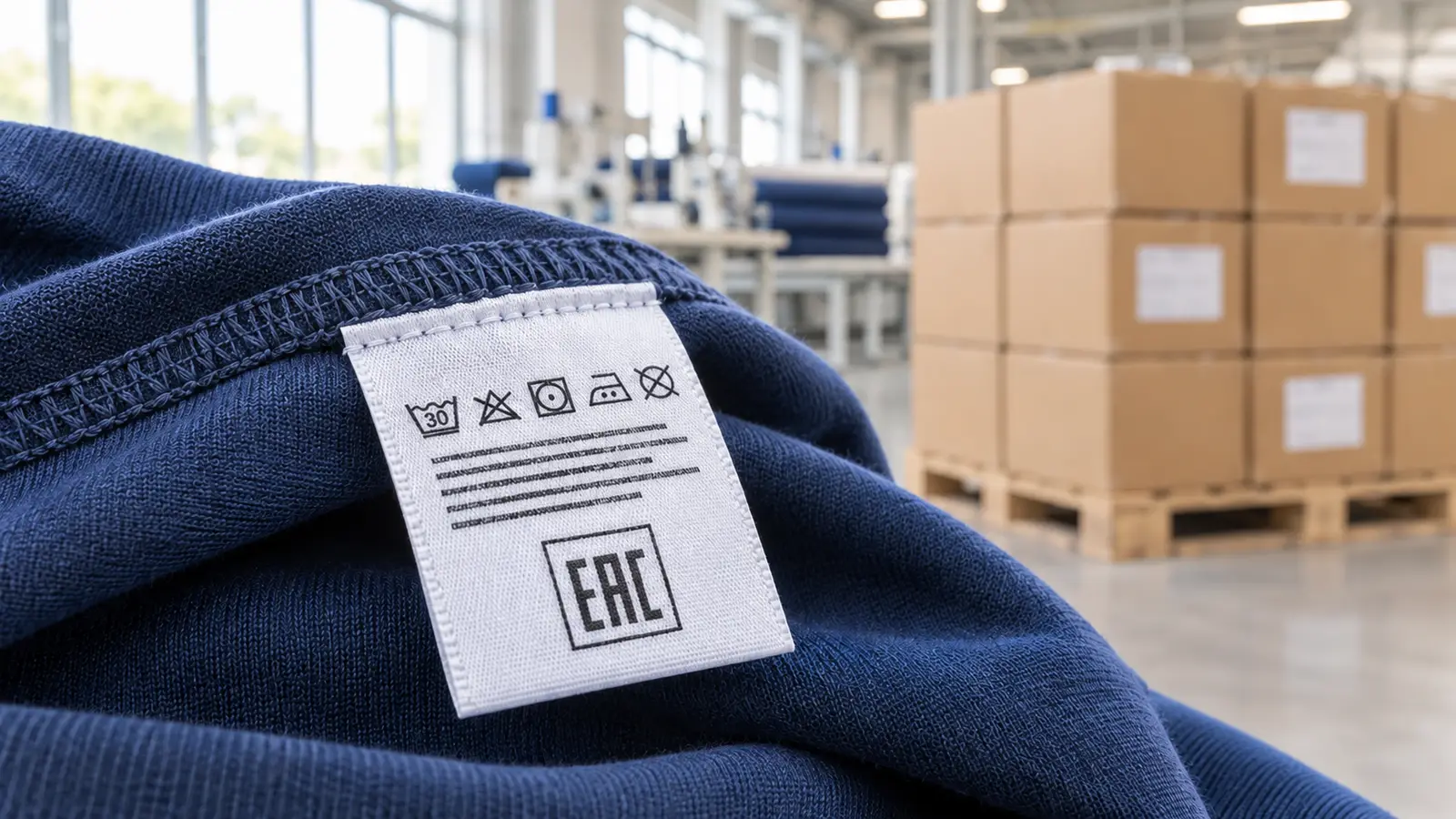
An EAC certificate is the certificate of conformity or declaration of conformity showing that your product has passed the conformity assessment required by the technical regulations of the Eurasian Economic Union. EAC stands for "Eurasian Conformity". The EAC mark on the product shows that it complies with every Union technical regulation that applies to it [1]. If your buyer in Russia, Kazakhstan, Belarus, Armenia or Kyrgyzstan asks you for an EAC certificate, your goods cannot go on sale in that market without it [2].
If you are shipping to one of these five countries for the first time, or again, and first heard about the document from your buyer, three decisions are waiting for you. Does your product need a certificate or a declaration? Who files the application? On which day must the document be valid at customs?
What is an EAC certificate and what does the EAC mark show?
A technical regulation is a document adopted by the Eurasian Economic Commission that sets binding product rules across Union territory [3]. Product groups such as toys, clothing and electrical appliances have separate regulations. Conformity assessment is how you establish, through testing, inspection or registration, whether a product meets those rules [4]. Whichever regulation covers your product sets its rules, its tests and the type of document.
"EAC certificate" is used for two different documents. A certificate of conformity is issued by an accredited certification body. A declaration of conformity is a registered document in which the applicant declares that the product complies with the regulation [4]. The Turkish Ministry of Trade (Ticaret Bakanlığı) sums up the order in its report on ready-to-wear: the product obtains a certificate or declaration of conformity, is marked with the EAC mark, and only then can be sold in Union territory [5].
We will follow one example throughout. A company in Denizli that makes adult underwear and T-shirts is preparing its first shipment to a retail chain in Kazakhstan. The buyer has asked for an EAC certificate.
The company's first question is the same as yours: what exactly is this document, and who gets it?
Why it matters: will goods without the document clear customs?
A product within the scope of a Union technical regulation cannot be placed on the Union market until it has passed the conformity assessment in that regulation. The rule is in Article 53 of the Treaty on the Eurasian Economic Union [2]. The assessment is done before the product reaches the market and cannot be completed afterwards [6].
Customs is where the rule first reaches your shipment. When a product subject to mandatory conformity assessment is imported, the document the regulation requires is presented to customs: a certificate, a declaration or another document listed in the regulation [7]. A product without one gets stuck at this stage.
The day on which the document must be valid is also fixed by rule. It must be valid on the date the customs declaration is registered [7]. With pre-arrival declaration, where the declaration is lodged before the goods arrive, the key day changes. It is then the day customs registers the document that amends the declaration or confirms no change is needed [7]. This comes from Council Decision No. 130, adopted in 2021. Decision No. 294 of 2012, still widely quoted, was repealed by it [8].
Example: Say your declaration expires on 30 June. The truck leaves Denizli on 26 June, and the customs declaration in Kazakhstan is registered on 3 July. On the day of registration, your document expired 3 days earlier. It was valid on the day the goods left, but customs looks at the registration date. Plan your renewal around the expected registration date of your last shipment.
The Ministry of Trade also notes that in Russia inspections are concentrated in customs zones. A customs officer can check the EAC document in front of them on the website of the Russian Accreditation Service and handle the clearance accordingly [9]. A fake or expired document comes to light when the shipment reaches the border.
There is one narrow exception to entry without a document: samples brought in for testing. If the person making the customs declaration has a contract with a conformity assessment body, or a letter from that body confirming the number of samples needed, the samples can enter without a conformity document [7]. No such route exists for a sales consignment.
In which countries is an EAC certificate valid?
An EAC certificate is valid in the five member states of the Eurasian Economic Union: Armenia, Belarus, Kazakhstan, Kyrgyzstan and Russia [10].
It makes no difference which member state you obtain it in. The right to use the EAC mark arises once the product has passed conformity assessment in any one of the member states [1]. Member states also cannot demand additional requirements or additional conformity assessment for a product that complies with the Union regulation [2]. The document the underwear maker in our example obtained for Kazakhstan is valid in Belarus too. But for a new buyer in Belarus to use it at customs, two conditions apply: it must be a serial production document, and the buyer must be authorised by the applicant or the manufacturer, with a copy sealed by them [7]. A batch document covers only its own shipment.
The exception is sanitary, veterinary and phytosanitary quarantine measures; the ban on additional requirements does not apply to them [2]. If you ship food or agricultural products, check these measures separately alongside the EAC document.
Uzbekistan is an observer state of the Union, not a member, and Tajikistan is not on the member list either [10]. If you ship there, check that country's own rules before relying on an EAC document.
EAC certificate of conformity or EAC declaration?
You don't make that choice; the technical regulation covering your product does. Mandatory confirmation of conformity takes the form of a declaration or a certificate, and only in the cases the relevant regulation provides for [4]. If the regulation says your product needs a certificate, a declaration will not get you through customs.
EAC certificate of conformity | EAC declaration of conformity | |
|---|---|---|
Who issues it | Accredited certification body | The applicant declares, and the document is registered |
What it rests on | Documents, sample tests, production analysis depending on the scheme | The applicant's declaration and the tests set by the scheme |
Factory visit | Depends on scheme and period: in Russia an expert visits for 3- or 5-year serial documents; a 1-year serial document is issued without a visit | Runs on sample testing |
For a certificate, the certification body reviews the documents you submit, the test and measurement results for the samples and, where the scheme calls for it, the state of production. If the result is positive, it issues the certificate to the applicant [11]. According to the Ministry's ready-to-wear report, in Russia an expert from a Russian laboratory or authorised body inspects the production site in person for a certificate [5]. The Ministry's general Russia report, however, says a 1-year serial document is issued without a visit, on samples and documents [9]. Ask the body whether a visit is needed for the scheme and period you choose.
A declaration, as the Ministry of Trade describes it, is a statement signed by the manufacturer or importer undertaking that the product complies with Union regulations [12]. In Russia, the declaration is entered into the accreditation authority's system [12]. A declaration may look like the lighter route, but it does not spare you the testing; the samples still go to the laboratory [5].
Back to Denizli. For ready-to-wear clothing, the governing regulation is the technical regulation on the safety of light industry products [5]. It divides garments into layers according to skin contact:
Product | Layer | Document required |
|---|---|---|
Underwear, corsetry, swimwear, socks, tights | Layer 1, direct skin contact | Certificate of conformity |
Jackets, pullovers, sweaters, vests, blouses, skirts, dresses, shorts | Layers 2 and 3, limited skin contact | Declaration of conformity |
The table is taken from the list in the Ministry of Trade's ready-to-wear report [5]. The company's underwear falls under certification. T-shirts are not named on this list, so the company confirms with the certification body before applying which layer they belong to: layer 1 means a certificate, layer 2 a declaration. Having two different document types in the same shipment is normal. Children's clothing falls under a separate regulation and is outside this example.
Who applies: can a Turkish manufacturer get the document in its own name?
No. The applicant must be a legal entity or sole trader registered under the law of one of the member states. That party can be the manufacturer, the seller or a person authorised by the manufacturer [6].
According to the Ministry of Trade, a manufacturer based in Türkiye must name a local company in Russia, Kazakhstan, Belarus, Armenia or Kyrgyzstan, and an EAC certificate cannot be issued directly in the manufacturer's name. A declaration likewise requires a representative company officially registered in one of the member states [12].
Another Ministry report says the application can be made by "the manufacturer or the importer" [5]. The two statements do not conflict. The manufacturer meant there is one registered inside the Union. Your factory in Türkiye does not fit that definition; your route runs through the importer or a contracted authorised representative.
That leaves you two options:
Your buyer, the importing company, becomes the applicant. The document is issued in its name.
You sign a contract with a company registered in a member state and appoint it as your authorised representative. The document is obtained through that representative.
The choice depends on whether you will sell to more than one buyer. A document obtained for serial production can also be used at customs by another person authorised by the applicant or the manufacturer. That person is given a copy of the document certified with the applicant's or manufacturer's seal [7]. In Kazakhstan, imports of vehicles and chassis are excluded from this option [7].
The Denizli company in our example could leave the first application to the retail chain in Kazakhstan. If it plans to sell to other buyers later, though, going ahead with its own authorised representative makes more sense, so that control of the document stays in its hands.
How to get an EAC certificate: the process step by step
First you link the product to the right technical regulation, then the applicant files with an accredited body, along with samples and documents. In Russian practice, a declaration is issued in about 2 weeks once the samples have been delivered to the laboratory. A certificate takes 2-3 weeks after the site audit and sample delivery [5]. The order is:
Find your product's technical regulation. The Eurasian Economic Commission publishes the list of regulations in force on its website [3]. Not every product needs an EAC certificate or declaration [9]; products outside every regulation are covered in the special cases section below.
Read the document type from the regulation. That is where the certificate-or-declaration question is answered [4]. The company in our example notes a certificate for underwear and a declaration for layer 2 products.
Decide who the applicant is. Your buyer or your authorised representative: settle it before you apply [6].
Pick a registered body and laboratory. Certification is carried out by a body listed in the Union's unified register of conformity assessment bodies, and testing is done in laboratories on that register [6]. Look up the name of the body you choose in the register.
Send the samples. In Russian practice, 3 samples are requested for each product composition, and the customs declaration states that the samples are being sent for testing at a Russian laboratory [5]. With a contract with the body, or a letter from it stating the number of samples, they can enter without a conformity document [7].
Prepare for a factory audit where needed. In Russian practice, an expert from the authorised body visits your site for 3- or 5-year serial documents; a 1-year serial document is issued on samples and documents, without a visit [9]. Ask the body whether a visit is needed for your scheme and period.
Check the document in the register. Once it is issued, open its entry in the unified register and compare the product name, applicant and validity dates with your own records.
Prepare the label and mark, and plan the shipment. The EAC mark goes on the product, the packaging or the accompanying documents before sale [1]. Work out the shipment date from the registration day of the customs declaration, not from the document's expiry date [7].
In our example, the work is split like this: the manufacturer in Denizli prepares the samples and product information, and the applicant in Kazakhstan files with the body. Whether an expert visits the site for the underwear certificate depends on the chosen scheme and validity period. If the T-shirts turn out to be layer 2, their declaration is registered after sample testing.
How long is an EAC certificate valid?
An EAC certificate can be obtained for a single shipment (batch) or for serial production for 1, 3 or 5 years [9]. For serial production, the legal ceiling for both certificates and declarations is 5 years; if the technical regulation sets a different period, that applies [11].
Document | Validity | How it is obtained |
|---|---|---|
Batch document | No period set; covers a specific shipment | By testing samples taken from the batch |
1-year serial document | 1 year | On samples and documents, with no expert visit |
3- or 5-year serial document | 3 or 5 years | After an audit visit by an expert from the authorised body |
No validity period is set for a batch certificate or declaration unless the regulation says otherwise [11]. The periods and visit details in the table come from the Ministry of Trade's 2026 Russia market information; according to the Ministry, a 3- or 5-year document is used in the customs clearance of every shipment within that period [9].
The choice depends on how often you ship. If the Denizli manufacturer will make a single trial shipment a year, a batch document is enough. With a regular supply agreement with the retail chain, a serial document removes the burden of retesting for every shipment.
One more detail. A standard scheme is the set procedure that says which tests and inspections the conformity assessment involves. Decision No. 44, which sets out these schemes, entered into force on 18 July 2018. For technical regulations adopted before that date, the old Decision No. 621 still applies in the parts that do not conflict with the regulation [13]. For older regulations such as the ready-to-wear one, always check the period in the regulation's own text.
How is the EAC mark applied to a product?
The EAC mark goes on each unit of the product, on the packaging or on the documents accompanying the product; the technical regulation decides where [1]. The right to apply it belongs to the manufacturer, a person authorised by the manufacturer and the importer, and only once the product has passed all required conformity assessment [1].
The rules on size and form are short. The base dimension must be at least 5 mm, the mark must be a single colour and must contrast with the surface it sits on. You can print it, weave it or use another method, as long as the mark stays clearly legible for the product's whole service life [1].
In ready-to-wear, the EAC mark is part of the Russian-language label. According to the Ministry of Trade's report, the label must show the product name and type, size, raw material composition in percentages, the names and addresses of the manufacturer and importer, the country of origin, care instructions, the production date and the EAC mark [5]. The company in our example can design the label before the document is issued, but it prints the mark on the product only afterwards.
Is the document genuine? Checking it in the unified register
Issued certificates and registered declarations are kept in the Union's unified register, which is published on the Union's official website and is open to everyone [6][14].
The unified register is fed by the national register sections of the member states [14]. A national register entry may also carry a QR code that takes you straight to the document record; the competent authority decides this [14]. In Russia, a customs officer can check the document on the Russian Accreditation Service website [9]. Run the same check yourself before you ship.
When the document reaches you, look at these points:
Does the document number show up in the register, and does its status look valid?
Is the applicant the buyer or representative you agreed on?
Do the product name, models and manufacturer details match your product?
Is the expiry date later than the registration day of your last planned shipment?
Don't set off with a document that is not in the register. Customs will run the same check, so the problem will surface at the border anyway.
Common mistakes and misinformation online
The costliest mistake is assuming the document can be sorted out after the shipment. Conformity assessment is done before the product is placed on the market [6]. The others:
"A Turkish manufacturer gets the document in its own name." It can't. The applicant must be a company registered in one of the member states [6][12].
"Certificate or declaration, we'll pick the cheaper one." The technical regulation sets the document type [4].
"A document obtained in Kazakhstan won't work in Russia." It will; member states cannot impose additional requirements on a product that complies with the Union regulation [2]. For another buyer to use it, though, it must be a serial production document with a copy sealed by the applicant or the manufacturer [7].
"If the document is valid on the day we cross the border, that's enough." Customs looks at the registration day of the declaration [7].
"The import rule is in Decision No. 294." That decision was repealed; the current rule is Decision No. 130 [8].
"Every product needs an EAC certificate." It doesn't; the document is only required for products covered by a technical regulation [9].
"A serial document can be used indefinitely." A serial production document is valid for up to 5 years, unless the regulation sets another period [11].
Special cases: GOST R, state registration and products out of scope
For some products an EAC certificate is not enough on its own, or not needed at all. Besides EAC, the documents most often requested in Russia include the GOST R certificate and declaration, the state registration certificate and the fire safety certificate [9].
GOST R is Russia's national document and shows that a product conforms to Russian state standards (GOST) [12]. Where an EAC certificate has been obtained, a separate GOST R certificate or state registration certificate is generally not required [12]. For products outside any Union technical regulation but subject to a member state's own mandatory certification, customs asks for the document set out in that country's law [7]. If you have such a product heading to Kazakhstan, see our Kazakhstan GOST-K certificate page.
State registration is an official record kept for products that need assessment on health, hygiene or environmental safety grounds; it is mandatory in particular for cosmetics, cleaning products and food supplements [12]. A fire safety certificate is requested for products where fire resistance matters [12].
If your product falls under no technical regulation, you can obtain an exemption letter from a body in Russia authorised to issue EAC documents. The letter states that the product is outside the scope of Union technical regulations and needs no EAC document; it is preferred as a way to avoid trouble at customs [12].
Shipping ready-to-wear to Russia? There is one more system you need to know. Most ready-to-wear products must be digitally marked and tracked through Russia's Chestniy ZNAK ("honest sign") system. The requirement started in 2023, and from 1 March 2025 new groups such as hats, gloves, ties and underwear were added [5]. This digital code does not replace the EAC mark; they are two separate obligations.
Your job this week is clear: find your product's technical regulation, read whether it calls for a certificate or a declaration, and agree in writing with your buyer on who the applicant will be. Once you have those three answers, you can reach us through our EAC certificate and declaration application page to put together the application file and sample plan with us.
This article is for general information and is not legal or financial advice. Technical regulations and customs rules can change; before you ship, confirm the current regulation that applies to your product against the official announcements of the Eurasian Economic Commission.
Last reviewed: 10 November 2026
Get a quote for EAC certificate
Share your product information and we will determine together which document is required.
Get a QuoteFrequently asked questions
Does a CE certificate replace an EAC certificate?
No. CE is for the European Union market. In the Eurasian Economic Union a product must pass the conformity assessment set out in the Union's own technical regulation and obtain an EAC certificate or declaration.
Is an ISO 9001 certificate enough for EAC?
No. ISO 9001 certifies a company's management system, not the product. Some EAC certification schemes also ask for the manufacturer's management system certificate, but it does not take the place of the product document.
Sources
- Gümrük Birliği Komisyonu, EAC tek dolaşım işareti ve uygulama usulü kararı No. 711 (2016 redaksiyonu)
- Madde 53
- Teknik düzenleme ve standardizasyon sayfası
- Uygunluk değerlendirmesi sayfası
- Rusya Federasyonu Hazır Giyim Sektörü Pazar Araştırması Raporu (2026)
- Birlikte uygunluk değerlendirmesi sunumu (2015)
- Zorunlu uygunluk değerlendirmesine tabi ürünlerin ithalat usulü kararı No. 130
- Zorunlu gerekliliklere tabi ürünlerin ithalatı kararı No. 294 (yürürlükten kalktı)
- Rusya Federasyonu Pazar Bilgileri (2026)
- Resmî tanıtım sayfası: üye ülkeler
- Tip uygunluk değerlendirme şemaları kararı No. 44
- Rusya Federasyonu Paketli Gıda Sektörü Pazar Araştırması Raporu (2025)
- 44 sayılı tip şemalar kararı hakkında sık sorulanlar
- Verilen sertifikalar ve kayıtlı deklarasyonlar ortak sicili kararı No. 46