
What is a certificate? Export product certification vs. declaration of conformity and ISO

In short
How does export product certification differ from a declaration of conformity and an ISO certificate? An authorised third-party body issues a product certificate, the manufacturer signs a declaration itself, and ISO 9001 covers the management system instead of the product. We explain which one EAC and CE call for.
- A product certificate shows, after testing, inspection or certification, that your product meets the technical regulation of the country it is going to.
- The manufacturer, importer or authorised representative issues a declaration of conformity itself; an authorised third-party body issues a certificate.
- ISO 9001 is granted to a company's management system and does not replace a product certificate.
- Only a body accredited in one of the Eurasian Economic Union countries can issue an EAC certificate.
- The EU has no central certificate for CE marking, and 'voluntary certificates' are not valid for CE.
In this article
- What is export product certification?
- Certificate, declaration of conformity and quality certificate: three separate documents
- Who issues a product certificate, and which one counts?
- Does your product need a certificate or a declaration, and how can you tell?
- Exporting to Russia and Kazakhstan: EAC certificate and EAC declaration
- Exporting to the EU: do you need a certificate for the CE mark?
- Special cases: voluntary certificates and the ISO logo on products
A product certificate is the document that shows, at the end of a conformity assessment, that your product meets the technical regulation or standard of the country it is going to. In export product certification, that assessment can be testing, inspection or certification: for example, a laboratory tests your product, or a body examines it and issues a document [1].
When your buyer or customs broker asks for "a certificate", they may mean one of three different documents: a product certificate issued by an independent body, a declaration of conformity that you sign, or an ISO certificate granted to your factory's management system. The technical regulation in your target market decides which one you need. The word your buyer happens to use does not.
Course and vocational certificates carry the same name.
This article leaves those aside and covers the document a manufacturer meets when selling products abroad: what a certificate is, how it differs from a declaration and an ISO certificate, and which one is required in Eurasia and the EU.
What is export product certification?
In export, a certificate is a document proving, through an assessment carried out by a body, that your product complies with that country's mandatory rules. Two concepts need separating first.
According to the World Trade Organization, meeting a technical regulation is mandatory, while meeting a standard is optional. An imported product that fails the requirements of a technical regulation cannot be put on sale [1]. Turkish law likewise defines a technical regulation as "mandatory legislation" setting out a product's characteristics, labelling, packaging or conformity assessment procedures [2].
Conformity assessment is the name for the technical procedures that verify a product meets these rules. Testing, verification, inspection and certification all fall under it, and the exporter generally pays the cost [1]. A body that tests or certifies products is called a conformity assessment body. Bodies that carry out calibration, testing, certification and inspection fit this definition [2].
A certificate is one of the documents that can come out of the process, and not every product needs one.
Some regulations leave the assessment to the manufacturer, and then the document is a declaration.
Certificate, declaration of conformity and quality certificate: three separate documents
What separates the three documents is who issues them and what they show. The manufacturer issues a declaration of conformity itself, an authorised third party issues a product certificate, and a quality certificate such as ISO 9001 covers the company's management system instead of the product.
Document | Who issues it | What it shows | Example |
|---|---|---|---|
Product certificate | Accredited or designated third-party body | The product's conformity with the technical regulation | EAC certificate [3] |
Declaration of conformity | Manufacturer, importer or authorised representative | The product's conformity, under the declarant's responsibility | |
Management system certificate | Certification body | The company's management system meets the standard | ISO 9001 [5] |
You can think of a declaration as "a promise made under your own signature", but it puts the responsibility on you. A manufacturer who draws up and signs the EU declaration of conformity is deemed to take responsibility for the product's conformity with the technical regulation [4]. Turkish law also assigns the manufacturer, where the legislation requires, the job of preparing the technical file, carrying out or commissioning the conformity assessment, drawing up the declaration of conformity and affixing the conformity mark to the product [2].
ISO 9001 does not replace a product certificate. The Turkish Standards Institution (TSE) states plainly that a management system certificate is granted to the relevant management system and not to the product [5]. If your buyer wants EAC or CE, the ISO 9001 certificate on your factory wall won't meet that request.
Example: Say you make agricultural machinery parts in Konya. Your buyer in Kazakhstan asks for "a certificate", your buyer in Germany says "CE", and you hold ISO 9001. All three requests lead to different documents. Kazakhstan calls for an EAC certificate or EAC declaration, Germany for an EU declaration of conformity and the CE mark. ISO 9001 stands in for the product document in neither market.
Who issues a product certificate, and which one counts?
A product certificate is issued by a body that the destination market recognises and that is authorised for that product. A document from any other body is useless in that market, even if it says "certificate" on top.
In the Eurasian Economic Union, only a certification body accredited in one of the Union's member states can issue an EAC certificate. The certificate is issued after that body's assessment. The assessment rests on technical documentation and test reports; in-house test reports are mentioned too, but the Turkish Ministry of Trade points mainly to reports from accredited testing laboratories. The certificate is printed on an official form validated by the accredited body's signature and seal [3].
In the EU, third-party assessment is done by a notified body. A notified body is an independent organisation designated by an EU country to assess the conformity of certain products before they are placed on the market. The European Commission publishes the list of these bodies in the NANDO (New Approach Notified and Designated Organisations) database, with each one's identification number and the tasks it has been designated for. The manufacturer may choose any notified body legally designated for the assessment procedure its product requires [6][7].
If a notified body is involved in the production control phase, its four-digit identification number appears next to the CE mark where the relevant regulation requires it [7][4].
Ask three questions to test validity:
In which country is the issuing body accredited or designated?
Does the body's authority cover your product and the relevant technical regulation?
Was the document granted to your product, or to your company's management system?
Does your product need a certificate or a declaration, and how can you tell?
Look at the technical regulation your product falls under. If it allows the manufacturer's own assessment, a declaration is enough; if it requires third-party assessment, you need a certificate. The European Commission's guidance is clear: where EU legislation allows self-assessment, you can assess your product without a conformity assessment body [7].
Make the decision in this order:
Find which technical regulation your product falls under in which market. In the EU, the CE mark is needed only for products covered by harmonised EU rules that specifically require it. If no such rule exists for your product, the CE mark must not be used; these products are subject to general product safety rules [7].
Read the conformity assessment procedure in that regulation. When the procedure allows self-assessment, you carry out the assessment. When it calls for third-party testing, you have to go to a notified body. The Commission says third-party assessment is usually required for higher-risk products such as medical devices, construction products and machinery [7].
Check every regulation your product falls under. Before affixing the CE mark, you must make sure you meet all the relevant requirements [7]. In that case the manufacturer draws up a single EU declaration of conformity covering all the regulations [4].
For Eurasia, check the Union's technical regulation. There, conformity is shown by an EAC certificate, an EAC declaration or registration. An EAC certificate is usually issued for "complex" products that the authorities consider to need thorough checks [3].
Where your product does not yet fall under a Union technical regulation, check the national standards and technical regulations of the member state concerned [3].
Your situation | What you do |
|---|---|
The regulation allows self-assessment | Carry out or commission the tests, prepare the technical file, sign the declaration of conformity |
The regulation requires third-party assessment | Choose a body authorised for your product and obtain the certificate at the end of the assessment |
The product falls under several regulations | Read each one's procedure separately; if one requires a third party, you go to a body for that part |
No EU rule requires CE for your product | Don't affix the CE mark; check the general product safety rules |
Back to the Konya example. If your part falls under EU machinery legislation, you first check whether that legislation allows self-assessment for your product type. If it does, the product going to Germany needs no certificate: you prepare the technical documentation, sign the EU declaration of conformity yourself and affix the CE mark [7]. On the Kazakhstan side you put the same question to the Union's relevant technical regulation, and the answer may be an EAC declaration or an EAC certificate.
Exporting to Russia and Kazakhstan: EAC certificate and EAC declaration
A product going to Russia or Kazakhstan enters the market with an EAC declaration or an EAC certificate, depending on the Eurasian technical regulation that applies to it [3]. The manufacturer, importer or authorised representative issues the declaration itself. A body accredited in one of the Union countries issues the certificate [3].
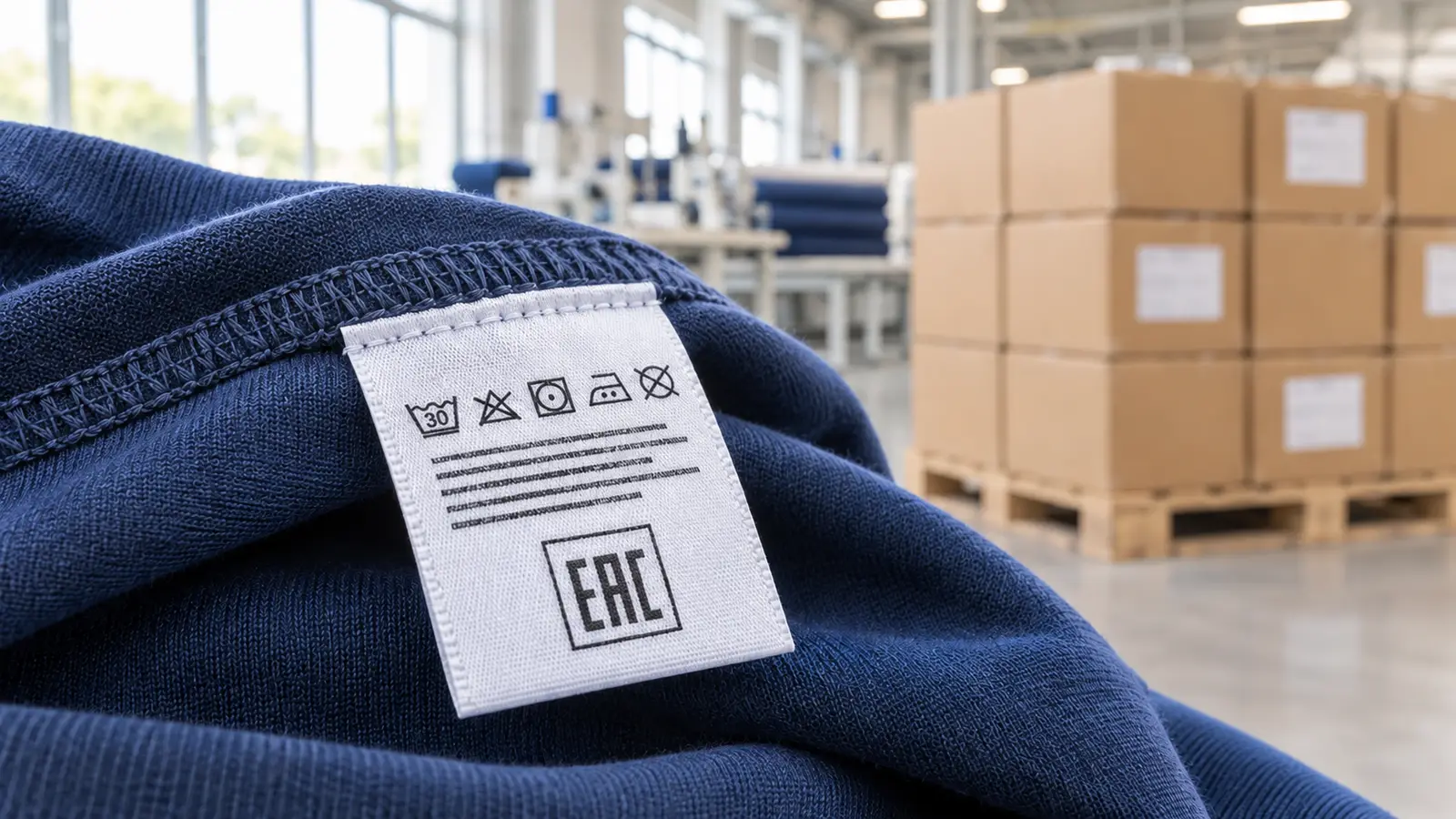
Union countries have applied the EAC document system since 15 March 2015 [3]. Because the rules are set at Union level, products going to Russia enter the same EAC system.
For an EAC declaration, the manufacturer can do the tests and analyses, and in some cases a laboratory does them. The declaration is listed in an official register [3]. With a certificate, the decision belongs to the accredited body.
Both routes end in the same place. A product found compliant is marked with the EAC mark and can move and be sold freely across the customs territories of the Union countries [3].
We explain the two types of EAC, who applies and the split by product group in our EAC certificate guide. Our EAC certificate and declaration service page walks through the application steps.
Exporting to the EU: do you need a certificate for the CE mark?
There is no central EU-issued certificate for the CE mark. The European Commission says no central EU body exists that authorises you to use the CE mark or issues a certificate for it [7].
You have four steps to take before affixing the CE mark [7]:
Identify all the EU requirements that apply to your product.
Decide whether you can assess the product yourself or need to go to a notified body.
Collect the evidence that your product meets the rules in a technical file.
Draw up and sign the EU declaration of conformity.
A certificate enters this process only when the regulation calls for third-party assessment. Then the notified body carries out the assessment and issues its document; the EU declaration of conformity then names this body, its identification number and the document it issued [4]. So in the EU a certificate never replaces the declaration. Where needed, it underpins it.
Responsibility lies with the manufacturer. If you make the product yourself, or have it made and sell it under your own name or brand, you are the manufacturer under EU rules [7]. Only the manufacturer or its authorised representative may affix the CE mark [4]. In Turkey, the general rules for CE marking are in the CE Marking Regulation published on 27 May 2021 [8].
As a medical device manufacturer, you will often face the notified body question too; our medical certification page covers this product group separately. For machinery and equipment manufacturers there is a machinery and equipment certification page.
Special cases: voluntary certificates and the ISO logo on products
The "voluntary certificates" some organisations sell are not valid for the CE mark. The European Commission writes that these documents have no legal recognition; they can be issued without the product being tested, used in areas outside the body's legal authority, and mislead both the customer and the market surveillance authority. You may affix the CE mark only after the correct conformity assessment defined by EU legislation, and only when your product requires it [7].
Someone selling you a single sheet called a "CE certificate"? Check three things: is the issuing body listed in NANDO as a notified body, is it designated for your product's legislation, and does the document actually rest on a test or assessment.
Printing the ISO logo on a product causes trouble too. Under TSE's rules, the IQNET mark granted with a management system certificate cannot be used on the product that reaches the end consumer. It cannot be used on the product's primary packaging (such as a milk carton) or secondary packaging (such as the pack holding several milk cartons) either [5].
The mark may be used only on secondary packaging the end consumer doesn't see, such as shipping cartons. Even then, a statement is added saying the certificate was granted to the management system and not to the product. The sample wording TSE gives reads: "This product has been manufactured in a facility certified as conforming to the Quality Management System standard TS EN ISO 9001:2015." [5]
The CE side has a similar limit. No marks or inscriptions that could mislead others about the meaning or form of the CE mark may be placed on the product [4].
This week, get your buyer to state in writing which document they want for which market. Then find the assessment procedure in your product's technical regulation for that market; that tells you whether you go with a declaration or a certificate. If your product is going to Russia or Kazakhstan and the answer is an EAC document, our EAC and GOST-R service page shows step by step how it is obtained.
This article is for general information only and is not legal advice. Last reviewed: 18.11.2026
Get a quote for EAC certificate
Share your product information and we will determine together which document is required.
Get a QuoteFrequently asked questions
Is a course or vocational certificate the same thing as the certificate required for export?
No. A course or vocational certificate shows a person's training or competence. The product certificate required for export shows that the product meets the technical rules of the country it is going to.
Do you pay a fee to put the CE mark on a product?
There is no fee for affixing the CE mark. The manufacturer does pay for the conformity assessment, for example testing by a notified body, and the amount depends on the product's complexity and the procedure.
How long must the EU declaration of conformity and technical file be kept?
According to the European Commission, the EU declaration of conformity and the technical file supporting it must be kept up to date and retained for at least 10 years after the product is placed on the market.