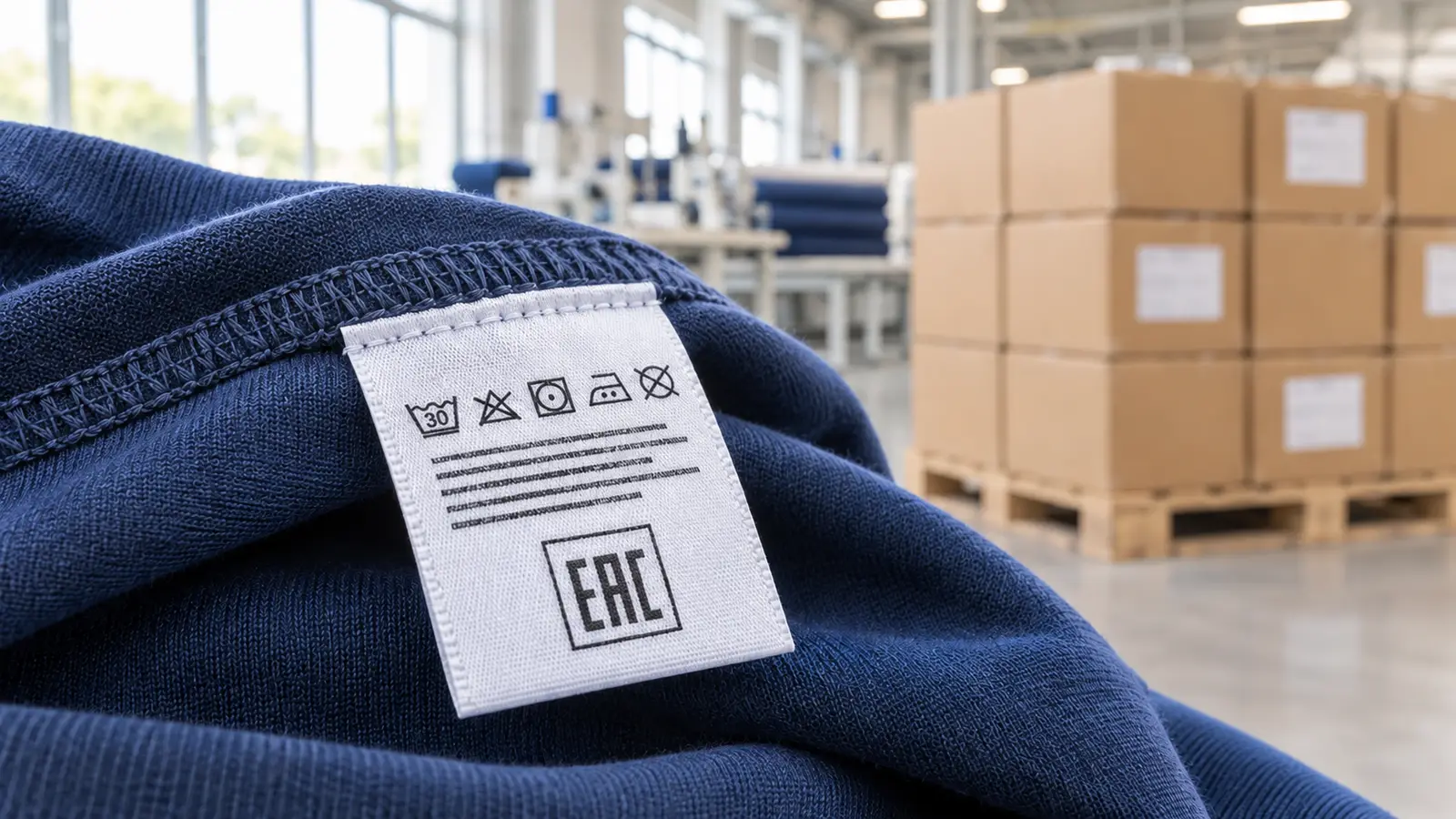

Why products without certificates get held at customs: EAC, labelling and TAREKS
In short
Customs looks for the document showing that the product meets the destination country's technical regulations, which is why products without certificates get held at customs. In Russia and the Eurasian Economic Union that document is an EAC certificate or an exemption letter; for imports into Türkiye the same check runs through TAREKS.
- In Russia, a customs officer can check an EAC document against the register of the Russian accreditation agency at fsa.gov.ru.
- When a product does not need EAC, the importer has to prove it: an exemption letter (otkaznoe pismo) from an authorised body is shown to customs.
- Since 1 July 2025, unlabelled imports of certain listed light industry products cannot be released into free circulation in Russia.
- In Türkiye, customs procedures for goods arriving by sea must be completed within 45 days of the summary declaration, and within 20 days for other routes; goods whose procedures have not started in time become liable to liquidation.
- A shipment rejected in TAREKS can first be challenged by objection or, for missing documents, reopened once; when that fails, it goes back to the origin country, moves on in transit, is sold for export or is abandoned to customs for destruc
In this article
- Why products without certificates get held at customs: four questions
- How customs checks an EAC document in Russia and the Eurasian Union
- The difference between an EAC certificate and an EAC declaration of conformity
- Products exempt from EAC still need proof: the exemption letter (otkaznoe pismo)
- Documents in order but no label: mandatory labelling in Russia (Chestny Znak)
- The same logic for imports into Türkiye: how TAREKS inspection works
- If TAREKS rejects the shipment: objection, return, transit or destruction
- Why the waiting time at customs matters
- Checklist before the goods leave
- Special cases: out-of-scope declarations and 2026 transition rules
Customs in the destination country looks for the document showing that your product meets that country's technical regulations, and it processes the goods on that basis. That is why products without certificates get held at customs. In Russia and the Eurasian Economic Union (EAEU) the document is an EAC certificate or an EAC declaration of conformity; when the product needs neither, you need an exemption letter proving it [1].
Are your goods waiting at Turkish customs right now? Then watch two clocks at once: the document deadline in TAREKS (the Risk-Based Control System in Foreign Trade, Türkiye's import inspection system) and the 20- or 45-day customs period [2]. When the documents will not make it in time, request an extension in TAREKS; the system grants one [3]. If TAREKS has already rejected the shipment, what you can do depends on the type of rejection; see the rejection table below. For goods waiting in Russia, settle with your buyer straight away whether the missing piece is the EAC document, the exemption letter or the label.
Our example is a company in Kayseri that makes small electrical household appliances. It has sold to Europe for years with CE, the EU conformity marking, and is now sending its first shipment to Russia. The same company also imports electrical devices from China.
Why products without certificates get held at customs: four questions
In the Eurasian Union, your goods get stuck at customs on one of these four questions:
Does the product have an EAC certificate or declaration of conformity, and does it appear in the register?
Does the document cover the model you are shipping and the right technical regulation?
Where the product does not need EAC, is there an exemption letter showing that?
Where the product is subject to mandatory labelling, is the label attached?
The safety requirements the Union sets for products, its technical regulations, are mandatory in every member state [4]. The members are Russia, Kazakhstan, Belarus, Kyrgyzstan and Armenia, and the same certification system applies in all of them.
So the CE marking the Kayseri company uses for the EU is not enough on its own in the Eurasian Union; the customs officer looks for the EAC document [1]. Ship a product that has sold in the EU for years as it is, and there will be no valid document to show at customs.
The user manual falls into the same trap. Under the Eurasian technical regulation for electrical products (low-voltage equipment), operating documents are prepared in Russian, and the language of the member state where the product is sold is added when that country's legislation requires it [5]. A manual the company wrote for the EU does not meet this requirement unless it is in Russian. Selling packaged food? Then the label has to be in Russian too [6].
Selling to other markets changes the name of the document, but the logic stays the same; we compare conformity documents for different countries in our certificate of conformity guide.
How customs checks an EAC document in Russia and the Eurasian Union
A customs officer can verify the EAC document you present on the website of ROSAKKREDITATSIYA, the Russian accreditation agency (fsa.gov.ru), and acts on what it shows [1]. This agency authorises the organisations allowed to issue EAC documents, and the validity and content of those documents are published on that site [1].
At customs, the registered document is the one that counts.
A document missing from the register, expired, or describing a product that does not match the shipment leaves you where you would be with no document at all.
A document identifies the product through three details: the product name, the type or model name given by the manufacturer, and the name of the technical regulation it shows conformity with [7]. The document presented to customs must prove the conformity of the imported product [8]. A model not named in the document, or a document obtained under a different technical regulation, does not cover that product. Who files matters as well: as a rule, the person submitting the customs declaration is the one named as applicant on the document, and someone else may use it only in specifically listed cases [8].
Run this check before loading. Search the document number in the ROSAKKREDITATSIYA register and compare these points with your invoice and shipping documents:
Are the product name and every model you ship written in the document?
Is the technical regulation in the document the one your product falls under?
Is the applicant your buyer, the party who will file the declaration in Russia?
Any mismatch then shows up for you before the customs officer in Russia sees it.
Your product decides which document you need. In Russia that means checking the lists of products subject to a mandatory certificate or declaration under GOST R, Russia's national certification system, the technical requirements of the Eurasian Economic Union, and the list of products requiring state registration [1]. Accredited certification centres operating across Russia issue the certificates, regardless of the region where the applicant company is registered [1].
The difference between an EAC certificate and an EAC declaration of conformity
They differ in what they rest on and how long they last [1]:
Declaration of conformity | Certificate of conformity | |
|---|---|---|
Based on | Documents submitted by the applicant | Test results |
Issued by | Certification body | Certification body |
Validity | 1 to 5 years | Up to 5 years |
With a certificate, the laboratory step cannot be skipped: no certificate is issued without a test report, so the products are tested first [1]. A document can be obtained for a single batch or for a period of 1, 3 or 5 years [1]. A batch document covers that one shipment only. Shipping several times a year with a new document each time means reopening the customs risk with every batch.
You do not pick one yourself. The technical regulation covering your product, or its place on the lists, tells you whether you need a certificate or a declaration [1]. The Kayseri company also starts by finding which list its products fall under.
How long the document takes and what it costs depend on the product, the testing required and the certification body. With the product name, model list and customs tariff code (Turkish: GTİP) in hand, we can prepare a time and fee quote specific to your product.
Products exempt from EAC still need proof: the exemption letter (otkaznoe pismo)
When your product does not need EAC, an exemption letter proving this must be shown to customs; in Russian it is called otkaznoe pismo, and the importer is the one who proves the exemption [1].
Some products in Russia are not subject to EAC and can enter the market without it. Customs does not accept the exemption on trust, though. The importer applies to one of the organisations authorised by ROSAKKREDITATSIYA that can also issue EAC documents, obtains a letter showing the product needs no document, and presents it to customs [1]. The letter is an official document approved by a certification centre, stating that a given product group is not subject to conformity assessment [1].
Since the importer in Russia obtains the letter, sending your goods off on the assumption that "no document is needed" is not enough. Before shipping, agree with your buyer on who holds the letter and which product group it covers. You will be the one supplying the product description, the GTİP and the technical details to the organisation. Our Turkish-language GTİP lookup guide explains how to find the code if you do not have it yet.
Documents in order but no label: mandatory labelling in Russia (Chestny Znak)
For a product subject to mandatory labelling, a complete EAC document does not help when the label is missing; the goods stop. For example, since 1 July 2025 unlabelled imports of certain listed light industry products cannot be released into free circulation [9]. Chestny Znak ("Honest Sign") is Russia's labelling system that tracks products individually by code.
Dates vary by product group. Mandatory labelling of textiles and clothing started on 1 January 2021; for certain light industry products listed separately in the Ministry's note, the timeline is [9]:
Date | What changed |
|---|---|
1 January 2021 | Labelling became mandatory for textiles and clothing (light industry) |
1 March 2025 | Labelling and offline verification became mandatory for certain listed light industry products |
1 July 2025 | Releasing unlabelled imports of these products into free circulation was banned |
1 January 2026 | Selling these goods without labels was banned |
Cosmetics and household chemicals were phased in step by step. Mandatory labelling started for soap and detergents on 1 May 2025. Hair and shaving products and deodorants followed on 1 July 2025, and cosmetics and toothpaste on 1 October 2025 [9]. Groups covered by the system also include footwear, perfumery, cameras and flashes, tyres, medical devices and bicycles [9].
Labels have to be applied before customs clearance, preferably at the production site or at a warehouse in Russia before clearance, and the importer is responsible [9]. Look up your product's GTİP in the list in Türkiye's Ministry of Trade information note on mandatory labelling in Russia. When it is on the list, settle with your buyer before shipping whether the codes will be printed at the factory or at the Russian warehouse.
The same logic for imports into Türkiye: how TAREKS inspection works
A product you import into Türkiye needs a TAREKS application when its GTİP is listed in the annex of one of the Ministry of Trade's import inspection communiqués [10]. TAREKS does not inspect every shipment: it sends the ones it flags as risky under set criteria to physical inspection [11]. The products to be inspected are set by communiqués published every year [12].
The main product group communiqués in force in 2026 are [13]:
Certain products that must carry the "CE" marking (2026/9): lifts, electrical and electronic devices, cameras, electric blankets, small household appliances.
Consumer products (2026/12): items such as stationery, imitation jewellery and wristwatches.
Construction materials (2026/14): items such as cement, iron and steel bars, insulation materials and door locks.
Machinery (2026/32).
The electrical device the Kayseri company brings in from China falls under the CE communiqué when its GTİP is listed in the annex [13]. The Ministry's 2026 guide for construction materials sets the process out step by step; guides for other communiqués may differ in detail [3]:
You apply in TAREKS and upload the documents in items one and two of Annex 3 of the communiqué with every application.
When the shipment goes to physical inspection, you upload the documents in items three and four in full within 20 working days, counting the application day. Should that not be enough, you can request an extension.
The inspector may take samples and send the product for testing. Shipping and testing costs fall on the importer; refuse the testing and the application is rejected.
The outcome is acceptance, conditional acceptance, permission to correct the goods in the customs-bonded area, or rejection. A product that fails a test gives you 15 working days to object to the test result.
Example: Say you file an application that gets sent to physical inspection on a Monday, and no public holiday falls in between. Since the application day counts, that Monday is working day 1 and Friday of the same week is working day 5. Four full weeks later, working day 20 falls on Friday of the fourth week. Your documents must be in the system before that Friday ends.
The same guide says test reports must be current, issued by an accredited laboratory and dated before the transport document, and the EU declaration of conformity must contain the elements in Annex 1 of the guide [3]. A test done after the goods have left carries a later date than the transport document and does not meet this rule.
Goods held for inspection are not always sent back. Where the shortcoming is minor, the application can end in conditional acceptance: you are asked to fix it as soon as import procedures are complete and in any case before placing the product on the market [3]. For a missing Turkish user manual, label, marking or packaging, you can ask to correct the goods in the customs-bonded area (Turkish: elleçleme) as long as there is no health or safety concern; once the request is approved, you get up to 30 days [3]. A missing brand, model or CE marking cannot be fixed this way. Submit the request in writing to the inspection unit first; handling permission obtained directly from the customs administration is not accepted [3].
That makes the manual the easiest gap to prevent. Goods sold to consumers must come with a Turkish introduction and user manual, and preparing it is the responsibility of the manufacturer and the importer [14]. When the manual is provided digitally, the product or its packaging has to show how to access it [15]. Having the Turkish manual for the Chinese device prepared at the ordering stage costs less than ending up with a 30-day correction in the customs area.
If TAREKS rejects the shipment: objection, return, transit or destruction
A rejection means the goods cannot enter Türkiye as they are, though depending on the type of rejection you may be able to object or reopen the application. The reason is sent in writing to the customs administration, and customs does not allow the product in [3]. You can object to a rejection only once, within 1 year, using the objection button in TAREKS [3].
After pressing the button you also need to send the objection by petition to the relevant Group Directorate; only then is it reviewed [3]. There is no objection route at all for "Rejection: Document Not Issued by the Competent Party" and "Rejection: Misleading Transaction" (Turkish: Ret: İlgilisince Düzenlenmeyen Belge, Ret: Yanıltıcı İşlem) [3].
A rejection caused by late uploads is fixed another way. When the documents are still not uploaded within the extended period, the system closes the application as "Rejection: Missing Documents" (Ret: Belge Eksikliği) [3]. The extension request button then lets you reopen the application for inspection once. The reopened application does not get the 45-day extension normally granted when the inspector asks for a document; you are asked to submit the missing documents within 15 working days [3].
Should the objection fail, or you never object, you are left with four routes [3]:
Return the goods to the country they came from.
Send them in transit to a third country, directly or via a free zone.
Sell them for export.
Abandon them, at your own expense, to the customs administration where they sit, for destruction.
Choose transit and transfer the goods to another company, and that company also needs a TAREKS registration for the transit permit [3].
Rejection result | What you do |
|---|---|
Rejection: Missing Documents | Reopen once with the extension request button and upload the missing documents within 15 working days |
Rejection: Inspection Result | Object once within 1 year; for test results, within 15 working days |
Rejection: Document Not Issued by the Competent Party, or Misleading Transaction | No objection route; return, transit, sale for export or destruction |
Why the waiting time at customs matters
Goods waiting at customs cost you money in two ways. Goods whose procedures have not started within the period become liable to liquidation under Article 177 of Türkiye's Customs Law [2]; until then, storage fees accrue every day. The periods:
Where | Rule |
|---|---|
Türkiye, by sea | 45 days from the summary declaration [2] |
Türkiye, other routes | 20 days from the summary declaration [2] |
Russia and other EAEU countries, temporary storage | Up to 4 months as a general rule [16] |
Storage fee, example: Gemport 2025 tariff | USD 0.50 per tonne per day [17] |
In Türkiye this period runs at the same time as the TAREKS document deadline. On a shipment arriving other than by sea, by road for example, the 20-day customs period can run out before the 20-working-day document period. The law allows the period to be extended when circumstances require [2], and an extension can also be requested in TAREKS [3]; when the documents are going to be late, request both without waiting.
While the goods wait, the temporary storage site charges for storage, loading, unloading and on-site handling, and operators must stay within the maximum rates set by the Ministry [2]. Each operator applies its own tariff. The Gemport tariff in the table is only an example: it applied to 2025, storage was collected monthly and invoices were issued at the foreign exchange selling rate of the Central Bank of the Republic of Türkiye [17]. Ask the operator where your goods sit for its current tariff.
Example: Say a 20-tonne shipment spends 30 days waiting for documents at a site charging USD 0.50 per tonne per day for storage. Storage comes to 20 × 30 × 0.50 = USD 300; loading, unloading and other services are extra.
Storage is not the only charge. When the container belongs to a shipping line, the line's own tariff may add container demurrage; ask the line for the amount. Miss the sales season, and the loss can exceed the storage bill.
Do not lean on the 4-month temporary storage period in Russia either: the Eurasian Economic Commission may set a shorter one for certain product groups [16].
Checklist before the goods leave
For a shipment to Russia, follow this order before loading:
Pin down the product's GTİP and use the Russian lists to find out whether it needs a certificate, a declaration of conformity, state registration or an exemption.
Decide between a serial production document and a batch document based on how often you ship.
Where a certificate is required, schedule the laboratory test.
Search the document number in the ROSAKKREDITATSIYA register; check that the product name and every model match the invoice and that the applicant is the party who will file the declaration.
Compare the technical regulation in the document with your product's place on the GOST R and Eurasian lists.
For an exempt product, confirm that the buyer holds the exemption letter from a body authorised by ROSAKKREDITATSIYA and that it covers this product group.
Check that the user manual, and the label where needed, is in Russian.
See whether the product is on the list in the Ministry's mandatory labelling note; when it is, agree with the buyer where the codes will be applied before clearance.
On its imports from China, the Kayseri company checks three things too. Which 2026 communiqué does the product fall under? What does that communiqué's inspection guide require for test reports and document deadlines? Is the device's Turkish manual ready?
Special cases: out-of-scope declarations and 2026 transition rules
From 2026 you declare that your product is outside a communiqué's scope directly through TAREKS rather than to customs; the fixed reference number used in earlier years has been abolished [10]. Every GTİP in the communiqué annexes now needs a TAREKS application. For an application sent to physical inspection, the inspection unit assesses whether the product is one the Ministry wants to inspect, based on the technical legislation and the description matching the GTİP [10].
The transition rules were kept narrow. Transition periods apply only to products whose transport document was issued before 1 January 2026 [10]. For these products, the previous year's fixed reference number could be used in out-of-scope applications made up to and including 28 February 2026; that date has passed [10]. Products that were under CE communiqué 2025/9 and moved to the machinery communiqué (2026/32) in 2026 could continue to be inspected under the provisions of 2025/9 during the transition period [10].
Because the communiqués are republished every year [12], these rules can change at the start of a year. Before the first shipment of a new year, confirm the current communiqué for your product on the Ministry of Trade's "Product Groups Inspected on Import" page.
Before your first shipment to Russia, the job is to settle, together with its GTİP and model list, whether your product needs a certificate, a declaration or an exemption letter. To handle that decision and the certification process with us and get a time and fee quote, see our EAC and GOST-R certification page for the information you need to apply.
This article is for general information only and is not legal advice.
Last reviewed: 13 November 2026
Get a quote for EAC certificate
Share your product information and we will determine together which document is required.
Get a QuoteFrequently asked questions
Are goods held at customs always sent back?
No. In a TAREKS inspection, a fixable shortcoming such as a missing Turkish user manual, label or packaging can lead to conditional acceptance or permission to correct the goods in the customs-bonded area within up to 30 days; a missing brand, model or CE marking cannot be fixed this way. Once a rejection is final, the goods are returned, sent in transit, sold for export or destroyed.
How long can goods without documents wait at customs?
In Türkiye, procedures for goods arriving by sea must be completed within 45 days of the summary declaration, and within 20 days for goods arriving by other means; goods whose procedures have not started in time become liable to liquidation. In the Eurasian Economic Union, the general rule for temporary storage is 4 months. Storage fees accrue throughout.
What is a state registration certificate in Russia?
It is the document issued for a finished product once the required tests are done and the state registration procedure at Rospotrebnadzor, Russia's consumer protection authority, is complete. It can be issued in the name of the importer or the manufacturer; the technical regulations of the Eurasian Economic Union decide which products need state registration.
Is there a penalty for selling unlabelled products in Russia?
Yes. When a product subject to mandatory labelling is sold without it, fines, confiscation and even imprisonment can apply, depending on the product type and on whether the offender is an individual or a company.
Which communiqué is TAREKS based on?
It is based on the Communiqué on the Risk-Based Control System in Foreign Trade (Product Safety and Inspection: 2025/28). The product group communiqués published every year decide which products are inspected.
Sources
- Rusya Federasyonu Pazar Bilgileri
- 4458 sayılı Gümrük Kanunu
- Yapı Malzemelerinin İthalat Denetimi Rehberi
- Teknik düzenleme ve standardizasyon
- Gümrük Birliği Komisyonu, TR CU 004/2011 Alçak Gerilim Ekipmanının Güvenliği Teknik Düzenlemesi (2011, 2023 değişiklikleriyle)
- Gümrük Birliği Komisyonu, TR CU 022/2011 Gıda Ürünlerinin Etiketlenmesi Teknik Düzenlemesi (2011, 2024 değişiklikleriyle)
- EAC sertifika ve uygunluk beyanı tek formları ve doldurma kuralları (Karar 293, 2012, değişiklikleriyle)
- Zorunlu uygunluk değerlendirmesine tabi ürünlerin AEB'ye ithalat usulü (Konsey Kararı 130, 2021)
- Rusya'da Zorunlu Etiketleme Bilgi Notu
- 2026 ÜGD tebliğleri geçiş süreci
- Ticaret Bakanlığı, TAREKS bilgi sayfası
- Ticaret Bakanlığı, İthalatta Ürün Güvenliği Denetimleri
- Ticaret Bakanlığı, İthalatta Denetimi Gerçekleştirilen Ürün Grupları
- Ticaret Bakanlığı, Tanıtma ve Kullanma Kılavuzu Yönetmeliği (2014)
- Tanıtma ve Kullanma Kılavuzu Yönetmeliğinde Değişiklik (2020)
- Avrasya Ekonomik Birliği, Gümrük Kodu md. 101: Geçici depolama süresi
- Gemport, 2025 Geçici Depolama Alanı ve Antrepo Tarifesi (Uludağ Gümrük ve Dış Ticaret Bölge Müdürlüğü sitesinde)